What PSI Should Commercial Truck Tires Be? Semi Truck Tire PSI Guide
When it comes to semi truck tire pounds per square inch (PSI), there’s no universal number that works across every rig, route, and load. Running the wrong pressure isn’t just inefficient; it directly impacts safety, semi truck tire life, fuel consumption, and compliance. If you’re operating on guesswork instead of data, you’re leaving performance (and money) on the table.
This guide breaks down how to set the correct PSI based on load weight, ambient temperature, and tread condition, the three variables that actually matter in real-world commercial operation.
Why Semi Truck Tire PSI Matters
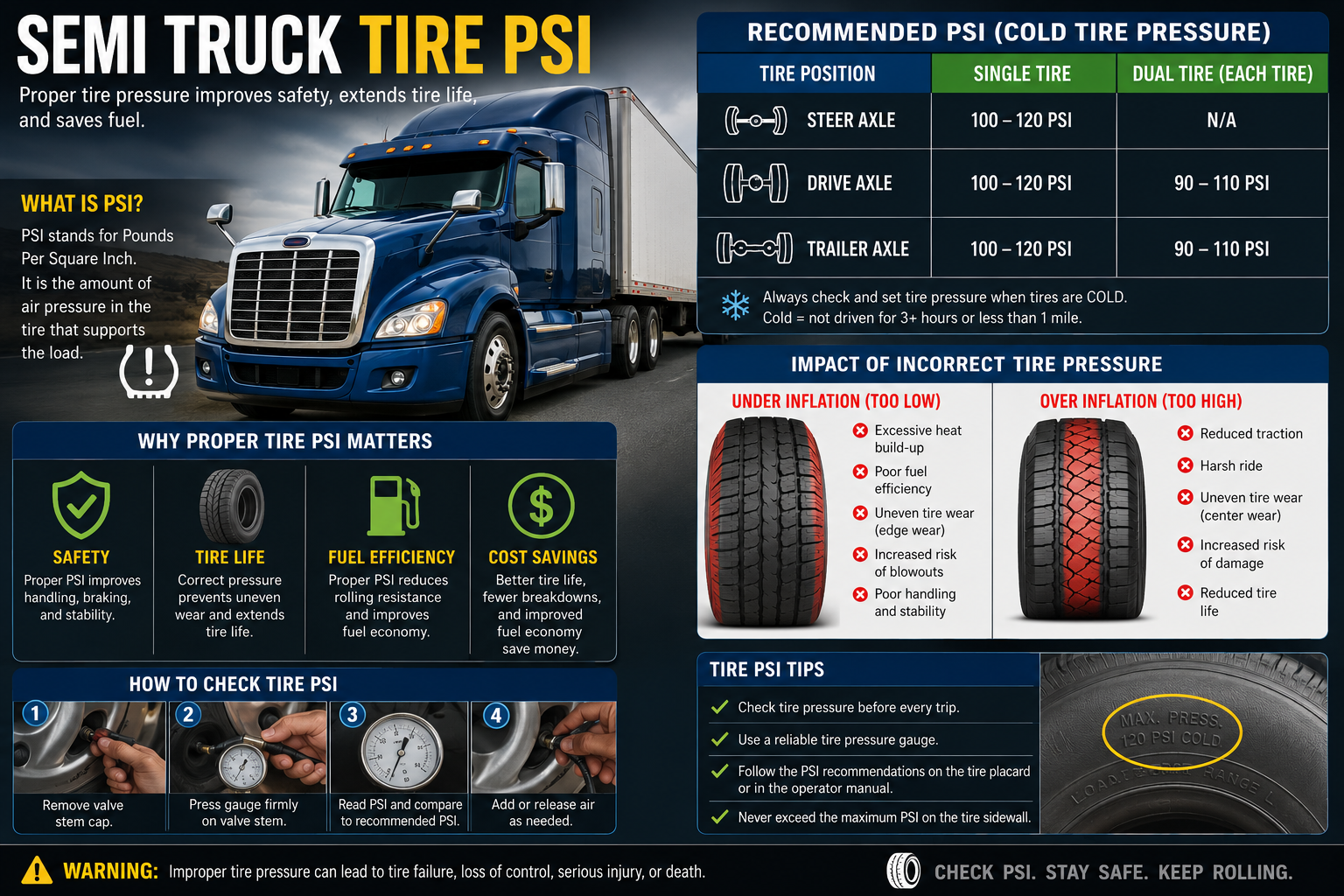
For commercial tires, PSI is not a static recommendation. It’s a calculated value tied to load and operating conditions. Underinflation and overinflation both introduce failure modes:
Underinflation
- Increased sidewall flex → heat buildup
- Higher rolling resistance → reduced fuel efficiency
- Accelerated shoulder wear → early tire failure
Overinflation
- Reduced contact patch → poor traction
-
- Center tread wear → shortened lifespan
- Increased risk of impact damage
For fleets and owner-operators alike, incorrect PSI translates into higher operating costs and more downtime.
PSI Based on Load Weight
Load is the primary variable for determining proper semi truck tire PSI. Every tire is designed to carry a specific load at a specific pressure. This relationship is defined by manufacturer load-inflation tables, not by what “feels right” or what another driver is running.
Key Principle:
Heavier loads require higher PSI to maintain structural integrity and prevent sidewall deflection.
Typical PSI Ranges (General Guidance Only):
- Steer tires: 100-130 PSI
- Drive tires: 85-110 PSI
- Trailer tires: 90-120 PSI
But here’s the reality: If you’re not matching PSI to axle weight, you’re guessing.
What You Should Actually Do:
- Weigh each axle (CAT scale or onboard system)
- Reference tire manufacturer load charts
- Set PSI accordingly, not uniformly across all tires
This is especially critical for operators hauling variable loads or running mixed routes.
PSI and Temperature: Why Cold Inflation Pressure Matters
Temperature directly affects air pressure. For every 10°F change in ambient temperature, tire pressure shifts by roughly 1-2 PSI.
Cold vs. Hot Pressure:
- Cold PSI: Measured before driving (baseline reference)
- Hot PSI: Increases during operation due to heat buildup
You should always set PSI when the tires are cold.
Example:
- Tire set to 100 PSI at 70°F
- Ambient drops to 30°F → PSI may fall to about 94-96 PSI
That drop is enough to push a properly inflated tire into an underinflated state.
Operational Impact:
- Winter = consistent pressure loss → requires frequent adjustment
- Summer = increased heat → risk of overexpansion if already near max PSI
Ignoring temperature swings is one of the fastest ways to reduce commercial tire lifespan.
PSI Based on Tread Wear Patterns
Your tires are already telling you if PSI is wrong. You just need to read the signals.
Common Wear Indicators:
- Shoulder Wear (Edges Worn Down)
- Cause: Underinflation
- Result: Excessive flex and heat
- Fix: Increase PSI and verify load alignment.
- Center Wear
- Cause: Overinflation
- Result: Reduced contact patch
- Fix: Reduce PSI to match load.
- Uneven or Cupped Wear
- Cause: Not always PSI (can be alignment or suspension), but incorrect pressure accelerates it
- Fix: Inspect alignment and verify inflation.
Bottom Line:
Tread wear is feedback. If you’re replacing tires frequently without diagnosing wear patterns, you’re treating symptoms, not the root problem.
Matching PSI to Application: Steer vs. Drive vs. Trailer
Not all positions on a semi truck require the same pressure strategy.
Steer Tires
- Carry the highest load per tire
- Require higher PSI for stability and control
- Typically run near max rated pressure
Drive Tires
- Must balance traction and load capacity
- Slightly lower PSI improves, grip but must stay within load requirements
Trailer Tires
- Often run higher PSI due to sustained load and minimal steering dynamics
- Consistency across axles is critical to avoid uneven wear
Treating all tires the same is a mistake. Each position has a different job, and PSI should reflect that.
The Role of TPMS and Monitoring
Manual checks aren’t enough anymore, especially in commercial applications.
Modern fleets rely on:
- Tire Pressure Monitoring Systems (TPMS)
- Real-time alerts for pressure drops
- Data logging for trend analysis
If you’re not actively monitoring PSI, you’re reacting to failures instead of preventing them.
When to Adjust PSI (Real-World Triggers)
You should reassess semi truck tire PSI when:
- Load weight changes significantly.
- Seasonal temperature shifts occur.
- You notice irregular tread wear.
- Fuel efficiency drops without explanation.
- Tires are replaced or rotated.
Static PSI settings don’t work in dynamic operating environments.
Financing Commercial Truck Tires Helps Reduce Downtime
Semi truck tires are a major operating expense, especially when replacing multiple positions at once. But delaying replacement or running worn tires at incorrect PSI often creates even larger costs through blowouts, irregular wear, fuel inefficiency, and unexpected downtime.
That’s why many owner-operators and fleet managers choose to finance commercial tires directly through their tire shop. Financing makes it easier to replace tires proactively instead of waiting for failures that take trucks off the road.
This can be especially useful for:
- Steer tire replacement
- Full tractor and trailer tire sets
- High-mileage commercial fleets
- Seasonal tire replacements
- Emergency roadside tire failures
For commercial operators, keeping trucks moving safely is often more important than minimizing upfront tire cost.
Why Commercial Tire Shops Matter More Than General Service Centers
Semi truck PSI management is not just about adding air. Load weight, tread wear, axle position, temperature, and route conditions all affect how commercial tires perform.
Dedicated commercial tire shops typically spend more time evaluating:
- PSI based on axle weight
- Heat-related wear patterns
- Steer vs. drive vs. trailer tire pressure
- Alignment-related tread wear
- Fleet tire performance trends
Instead of treating PSI like a generic number, experienced commercial tire shops build pressure strategies around how the truck is actually operating in the real world.
For fleets and owner-operators alike, that expertise can make a major difference in tire lifespan, fuel efficiency, and long-term operating costs.
Commercial Tire Expertise That Goes Beyond the Basics
At Cook Tire, commercial operators across East Texas rely on real expertise, not guesswork. Whether you’re managing a fleet or running independently, proper PSI is just one piece of the equation.
From commercial tires in Nacogdoches to full-service inspections, alignments, and replacements, Cook Tire provides the data-driven approach needed to keep trucks operating efficiently and safely.
Shop Tires Online and Get It Right the First Time
If your current tires aren’t performing (or you’re not confident in your PSI strategy), it’s time to take control.
Shop tires online with Cook Tire to access the right commercial tires for your application, backed by expert guidance and real-world support.
Or, bring your truck into one of their East Texas locations for a full inspection and PSI optimization.