
How to Read Tractor Tire Sizes: What the Numbers and Letters Mean
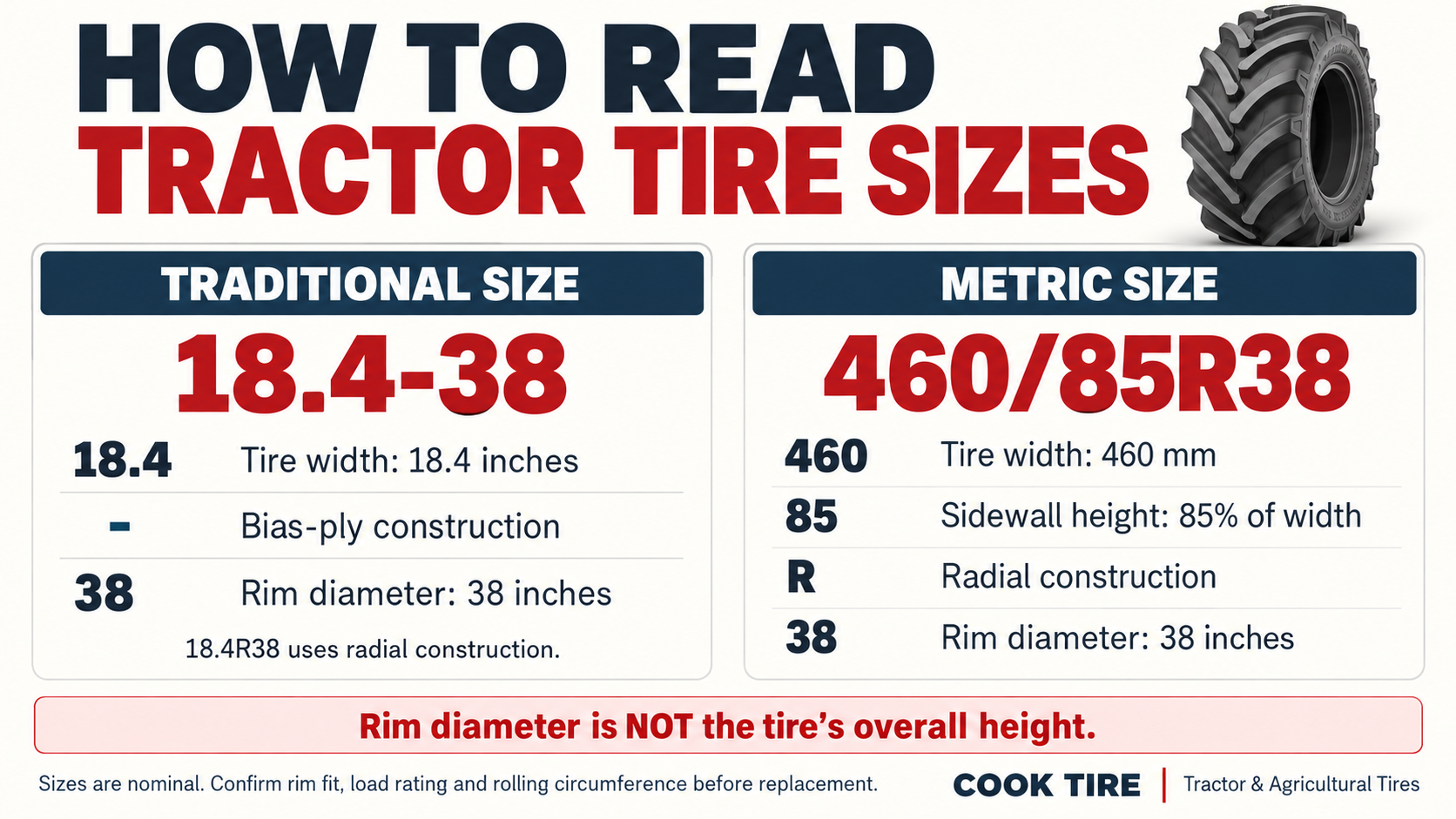
Tractor tire sizes can look confusing because agricultural tires use several different naming systems. You might see 18.4-38, 18.4R38, or 460/85R38 on tires that are similar in overall dimensions but use different construction or sizing conventions.
The basic rule is simple:
- Traditional sizes such as 18.4-38 use inches
- Metric sizes such as 460/85R38 use millimeters for width and a percentage for sidewall height
- R means radial construction
- A dash generally indicates biased construction
- The final number identifies rim diameter in inches
Other markings—including IF, VF, load index, speed rating, R-1, R-1W, TL, and TT—tell you how the tire is built and what it is designed to do.
Cook Tire provides tractor and farm tires throughout East Texas for tractors, combines, implements, agricultural equipment, and other demanding applications.
What Does a Tractor Tire Size Mean?
A tractor tire size identifies the tire’s nominal width, profile or construction, and the diameter of the wheel it fits.
Consider three common examples:
18.4-38
18.4-inch nominal width + bias construction + 38-inch rim
18.4R38
18.4-inch nominal width + radial construction + 38-inch rim
460/85R38
460-mm nominal width + 85% aspect ratio + radial construction + 38-inch rim
All three provide useful dimensional information, but they are not automatically interchangeable simply because the numbers appear similar.
Load capacity, rolling circumference, approved rim width, tire construction, tractor drivetrain, and manufacturer recommendations also matter.
How Do You Read a Traditional Tractor Tire Size Like 18.4-38?
In an 18.4-38 tractor tire, 18.4 is the nominal tire width in inches, the dash indicates bias-ply construction, and 38 is the rim diameter in inches.
Break it down:
18.4
The first number represents the tire’s nominal section width.
An 18.4-38 tire is approximately 18.4 inches wide, although the actual mounted width varies somewhat depending on the manufacturer, rim width, inflation pressure, and load.
–
The dash indicates conventional bias-ply construction.
Bias tire body cords run diagonally across the tire in overlapping layers.
38
The final number is the rim diameter, not the tire’s outside diameter.
An 18.4-38 tire mounts on a 38-inch-diameter agricultural rim.
This traditional system remains common on older tractors and many modern biased agricultural tires.
What Does 18.4R38 Mean?
An 18.4R38 tire has approximately an 18.4-inch nominal width, radial construction, and fits a 38-inch rim.
The important difference is the R.
18.4R38
- 18.4 = nominal width in inches
- R = radial construction
- 38 = rim diameter in inches
An 18.4-38 and 18.4R38 may appear similar in basic size, but one is biased and the other radial.
That difference affects how the casing flexes, how the tire places its footprint on the soil, traction characteristics, ride quality, inflation requirements, and often price.
Cook Tire discusses these differences further in its guide to tractor tire costs and long-term value.
How Do You Read a Metric Tractor Tire Size?
In a size such as 460/85R38, 460 is the nominal width in millimeters, 85 is the aspect ratio, R means radial, and 38 is the rim diameter in inches.
Consider:
460/85R38
460 = Tire Width
The tire is approximately 460 millimeters wide.
To convert millimeters to inches:
460 ÷ 25.4 = approximately 18.1 inches
That is why 460/85R38 commonly appears in the same general size family as the older 18.4R38 designation.
85 = Aspect Ratio
The sidewall height is approximately 85% of the nominal section width.
For a 460/85R38:
460 × 0.85 = 391 mm
That means the nominal sidewall height is roughly 391 millimeters.
R = Radial
The tire uses radial casing construction.
38 = Rim Diameter
The tire mounts on a 38-inch rim.
Agricultural tire sizing, therefore, mixes metric and imperial measurements within the same designation.
What Does the Aspect Ratio Mean on a Tractor Tire?
The aspect ratio tells you how tall the tire’s sidewall is relative to its width.
For example:
480/80R42
The tire is 480 mm wide, and its nominal sidewall height is 80% of 480 mm.
480 × 0.80 = 384 mm
A lower aspect ratio generally results in a shorter sidewall relative to tire width.
This makes it possible for different tire sizes to achieve similar overall diameters while using different widths.
For example, agricultural manufacturers may offer several width-and-aspect-ratio combinations within similar rolling-circumference groups.
That flexibility allows farmers to choose narrower row-crop tires, wider flotation tires, or other configurations without necessarily making a dramatic change in overall tire height.
Is 460/85R38 the Same as 18.4R38?
They are commonly treated as comparable size designations, but replacement compatibility should be confirmed from the specific tire manufacturer’s dimensions and rolling-circumference data.
A modern 460/85R38 is commonly listed as an equivalent or replacement for an 18.4R38.
However, nominal size equivalence does not mean every tire has identical:
- Overall diameter
- Loaded radius
- Section width
- Rolling circumference
- Approved rim width
- Load capacity
Those differences become particularly important on four-wheel-drive and mechanically assisted front-wheel-drive tractors.
Before replacing one designation with another, confirm the manufacturer’s dimensional specifications.
Why Is Rolling Circumference Important on a Tractor?
On tractors with driven front and rear axles, tire rolling circumference must maintain the drivetrain’s intended front-to-rear speed relationship.
Two tires can fit the same diameter rim but have different outside diameters and rolling circumferences.
On a two-wheel-drive tractor, a modest dimensional difference may mainly affect ground clearance, gearing, or speed.
On MFWD and 4WD tractors, the relationship between front and rear tire rolling circumference is much more important.
The front tires are generally designed to travel at a specific ratio relative to the rear tires. Installing the wrong tire combination can create excessive lead or lag and place unnecessary stress on drivetrain components.
For this reason, matching rim diameter alone is not enough when changing tractor tire sizes.
What Do IF and VF Mean on Tractor Tires?
Improved Flexion (IF) and Very High Flexion (VF) are agricultural tire standards that allow greater load capacity at a given pressure or operation at lower pressure for a given load compared with a standard radial tire.
You may see a size such as:
IF480/80R42
or
VF480/80R42
The letters appear before the basic size.
IF — Improved Flexion
IF tires are designed with casings capable of additional flexing.
Under applicable manufacturer load and speed tables, IF technology can generally support approximately 20% greater load at the same pressure or the same load at roughly 20% lower pressure than a comparable standard radial.
VF — Very High Flexion
VF tires take the concept further.
They can generally support approximately 40% more load at the same pressure or the same load at approximately 40% lower pressure, subject to the manufacturer’s load and speed specifications.
Lower field pressure can increase tire footprint and help reduce soil compaction while maintaining the required load capacity.
IF and VF are therefore not simply marketing names. They identify specific agricultural tire capability standards.
What Does the Load Index Mean?
The load index is a numerical code representing how much weight the tire can support under specified operating conditions.
A modern agricultural tire may have a designation such as:
460/85R38 154A8
The 154 is the load index.
It does not mean 154 pounds, kilograms, or PSI. The number corresponds to a standardized load-capacity table.
Load capacity also depends on inflation pressure, speed, tire configuration, and application.
Agricultural tires are particularly sensitive to the relationship between load, speed, and pressure.
That means the maximum load printed or listed for a tire should not be used as a universal operating value without consulting the manufacturer’s load-and-inflation tables.
What Does A8, B, D, or E Mean?
Letters such as A8, B, D, and E are agricultural tire speed symbols indicating the maximum rated operating speed under specified load conditions.
A tire might display:
154A8/154B
This indicates that the tire has load ratings associated with two different speed categories.
Common agricultural speed symbols include:
- A8 = 40 km/h, approximately 25 mph
- B = 50 km/h, approximately 31 mph
- D = 65 km/h, approximately 40 mph
- E = 70 km/h, approximately 43 mph
The load the tire can safely carry may change with operating speed.
Always use the tire manufacturer’s tables to determine pressure and load limits, rather than relying on the speed letter alone.
What Does R-1 Mean on a Tractor Tire?
R-1 identifies an agricultural drive-tire tread classification designed for general field traction. It is a tread designation, not a tire size.
Common agricultural tread classifications include:
R-1
Standard agricultural drive tread used for general farming and traction.
R-1W
A deeper agricultural traction tread than conventional R-1 designs, commonly selected for wetter or more demanding field conditions.
R-2
Extra-deep traction tread is commonly associated with very wet conditions, such as rice and cane applications.
R-3
A shallower, less aggressive tread is often used where flotation and reduced surface disturbance are priorities.
Cook Tire carries multiple agricultural tire types for East Texas farms and can match tread design to soil conditions and equipment use.
What Do TL and TT Mean?
TL means tubeless, and TT means tube type.
These markings tell you whether the tire is designed to operate without an inner tube.
TL = Tubeless
The tire and compatible rim retain air without a separate inner tube.
TT = Tube Type
The assembly requires an appropriate inner tube.
Whether a tire can be operated tubeless also depends on the wheel and rim design.
Do not assume that a tubeless tire can automatically be installed tubeless on every older agricultural rim.
What Does Ply Rating Mean?
Ply rating is a load-strength classification used particularly on bias agricultural tires; it should not be interpreted simply as the literal number of fabric layers inside a modern tire.
You might see:
8 PR
or
12 PR
Historically, more cotton cord plies were used to create stronger tires. Modern materials can provide equivalent strength with fewer physical layers.
Ply rating, therefore, functions primarily as a strength and load-capability category.
When replacing a tire, select one with sufficient load capacity for the tractor, attachments, ballast, and operating conditions rather than simply copying a ply number without checking specifications.
Can You Put a Different Size Tire on a Tractor?
Sometimes, but replacement sizes must be checked for rim compatibility, load capacity, overall diameter, clearance, rolling circumference, and drivetrain requirements.
Changing tractor tire size can be useful when an operator wants:
- Greater flotation
- Reduced soil compaction
- Narrower row-crop clearance
- Higher load capacity
- Different ground clearance
- Improved traction
But changing one number affects several other dimensions.
A wider tire may need a different rim. A different aspect ratio changes the sidewall height. A larger overall diameter changes the rolling circumference.
On four-wheel-drive equipment, changing one axle without correctly matching the other can create drivetrain problems.
Professional tire selection becomes particularly important when moving away from the tractor’s original size.
How Do I Find the Correct Tractor Tire Size?
Start with the existing tire markings and tractor specifications, then confirm the tire’s rim, load, speed, and rolling-circumference requirements.
Useful information includes:
- Current front and rear tire sizes
- Tractor make and model
- Two-wheel drive, MFWD, or 4WD
- Rim diameter and width
- Typical axle load
- Ballast
- Implements carried
- Field versus road operation
- Desired tread type
Do not select an agricultural tire based on dimensions alone.
Two tires of the same nominal size may have different load ratings, tread designs, flexion technology, recommended rims, and operating pressures.
Cook Tire’s farm and tractor tire specialists can help compare these specifications before installation.
Tractor and Agricultural Tires in East Texas
Understanding the numbers on a tractor tire makes replacement much easier.
A traditional 18.4-38 identifies an approximately 18.4-inch-wide bias tire for a 38-inch rim. A 460/85R38 identifies a 460-mm-wide radial tire with an 85% aspect ratio for the same rim diameter.
Additional markings then indicate flexion technology, load capacity, speed capability, tread design, and tube requirements.
Cook Tire supplies tractor and agricultural tires for farmers and equipment operators throughout Lufkin, Nacogdoches, Livingston, and surrounding East Texas communities. The company also provides on-site agricultural tire service and a wide range of farm, commercial, OTR, and specialty tire options.
If you’re replacing an older size or considering a different agricultural tire configuration, checking the complete tire specification can prevent fitment problems and help ensure the tire delivers the traction, load capacity, and field performance your equipment requires.
Frequently Asked Questions
What does 18.4-38 mean on a tractor tire?
18.4 is the nominal tire width in inches, the dash indicates bias construction, and 38 is the rim diameter in inches.
What does 460/85R38 mean?
460 is the nominal width in millimeters, 85 means the sidewall height is approximately 85% of the tire width, R indicates radial construction, and 38 is the rim diameter in inches.
What is the difference between 18.4-38 and 18.4R38?
An 18.4-38 is traditionally a bias-ply tire. An 18.4R38 uses radial construction. Both have similar nominal width and fit a 38-inch-diameter rim, but their construction and operating characteristics differ.
Is 460/85R38 equivalent to 18.4R38?
460/85R38 is commonly listed as a metric equivalent to 18.4R38. Exact overall diameter, width, rolling circumference, and load specifications can vary by manufacturer, so compatibility should still be verified.
What does IF mean on a tractor tire?
IF means Improved Flexion. IF agricultural tires are designed to carry an additional load at the same pressure, or the same load at lower pressure compared with standard radial tires, within specified operating limits.
What does VF mean on a tractor tire?
VF means Very High Flexion. VF tires provide greater flexion capability than standard or IF radials and can generally operate at substantially lower inflation pressure for the same load, or at a higher load at the same pressure.
What does R-1 mean on a tractor tire?
R-1 is an agricultural tread classification for general-purpose drive tires. R-1W uses a deeper traction tread, while R-2 and R-3 are intended for different agricultural conditions.
Can I change tractor tire sizes without changing wheels?
Sometimes. The replacement tire must be approved for the existing rim width and diameter and must provide appropriate load capacity, clearance, and rolling circumference. MFWD and 4WD tractors also require correct front-to-rear tire matching.